
Skip to content
View in the app

A better way to browse. Learn more.

The Patriot Woodworker

A full-screen app on your home screen with push notifications, badges and more.

To install this app on iOS and iPadOS
  1. Tap the Share icon in Safari
  2. Scroll the menu and tap Add to Home Screen.
  3. Tap Add in the top-right corner.
To install this app on Android
  1. Tap the 3-dot menu (⋮) in the top-right corner of the browser.
  2. Tap Add to Home screen or Install app.
  3. Confirm by tapping Install.

Blogs

Featured Entries

I really thought I had finished this post and discovered today that was not the case . So here goes. Now the lumber was finally here and cutting parts to size and glue up for thicker parts begins.                       These wider pieces were real fun doing the glue up on. Kinda like holding a snake who wants to run. The next photo is the legs. Note I used a waxed spacer to keep the slots open and spaced properly for end cross sup
Gerald
I readily admit, I have not tried all of the drying methods we have discussed. Out of those I have tried, I found a combination of methods works well for me.   My preferred method- 1. As soon as possible, slice the log into bowl blank desired thickness and seal the ends with TiteBond wood glue. 2. When ready to turn a bowl, rough turn it leaving a consistent wall thickness about 1/10 the diameter of the blank. 3. Place the rough turned blank in a solution of dishwashing
lew
Bowl blanks can be dried using "chemistry". Submerging the blanks in various liquids can actually facilitate the loss of moisture.     Before the pandemic, denatured alcohol was readily and turners would soak their blanks in it. Several sources of information on this-   From the AAW- https://www.aawforum.org/community/threads/is-the-alcohol-drying-method-food-safe.9682/   From Mr. David Reed Smith- http://alcoholsoaking.blogspot.com/   and-
lew
Woodturners took a page out of the lumber industry playbook for drying their bowl blanks. If you can speed up drying lumber, why not a bowl blank. Turners have been building/repurposing equipment to create drying kilns for some time.    The trick to incorporating this method is not to dry the bowl blanks too quickly. As with the previous methods, controlling the moisture loss to equilibrium is a balancing act. Too slow and you'll grow old waiting as well as mold can grow on the blanks.
lew
Containers and shavings slows the drying process but can take up extra space in the shop, especially if you have a bunch of blanks in different stages of drying.   Another method of slowing the drying is to put a sealer directly on the surface of the blanks. This can work for the rough CUT blanks and the rough TURNED blanks. The sealer slows the transfer of the moisture from the wood to the air. The majority of the moisture is lost through the end grain pores. Sealing those areas is really impor
lew
Bowl drying, without cracks, is accomplished by slowing down the escaping moisture until moisture equilibrium (emc) between the bowl and the ambient air is achieved. As a turner, we can improve the odds of successful drying- regardless of the method used- by assuring the roughed out blank walls have a consistent thickness and round over sharp corners/edges before starting the drying process.   One of the earlier more successful methods of achieving slow drying was to surround the blank
lew
The bowl drying adventure continues......   In the beginning, all my knowledge came from books. Isolated in the northern end of the Cumberland Valley and before high speed Internet and YouTube, even written publications on the subject were few and far between. Cheap tools and a cheap lathe were able to produce some rudimentary turnings including some small bowls- of which most cracked. To me drying meant just that- set it up on the shelf and wait.   As fate would have it, som
lew
Drying Turned Wood by Gerald Lawrence   I will cover the method I use as well as some other methods which have been up and down in popularity in the woodturning world to dry a blank in a method of turning called Twice Turned. First what is Twice Turned (TT) . TT is when you rough turn a bowl (usually only green wood) down to a wall thickness equaling one-tenth of the diameter of the bowl, the turn again when it reaches moisture equalization (MEQ) to final finish.   1. Ba
Gerald
One headache to me is adjusting the movement of the tool rest in and out.  There are newer screws that use a lever.  At the moment, I cannot find them.  But, this is what we SSer's do.       It cannot be overemphasized, to make these adjustments, please turn off the machine.  After making your adjustments, spin your wood by hand to ensure that there is sufficient clearance between the turning stock and the tool rest.  Also, ensure you tighten the height adjustment sufficient
FlGatorwood
Now that the tailstock is installed and aligned, it is doubtful that you will ever have to do this again for many years.  Only the tail stock has to be adjusted to the headstock.  Now, we have options of tools to look at.       Whereas the previous pictures showed a dead center, this is live center.  This has bearings in it and the tip and head spin.  I sometimes put oil in the back while the tip is down.  I hope the oil runs in.  These are found on various woodworking sites.  All
FlGatorwood
So you get a Shopsmith and it is new to you.  This versatile machine will do or help you do many things in woodworking.  Some folks think that this machine is only a lathe, but it is so much more.  This is dedicated to the Mark V (500 series - 500, 505, 510, 520 including the Power Pro).  You should inventory to see if you have the following parts.     In the lower left is the powerhead with the quill showing.  On the masonite board are the tool rest, live center, dead center, bo
FlGatorwood
Wood is ready for the pattern with the backer board attached in the 4 corner with counter sunk screws... I first roll out Scotch Brand packing tape to cover all the area.......There are lots of types of Scotch Brand packing tape. Storing, Packing and Shipping and maybe more but the shipping is thicker and doesn't tear apart as easy you are removing it off the wood. I then spray temporary glue on the tape then lay on pattern. Duck brand clear tape leaves too much stickum on the wood after it is r
Smallpatch
Better add some sort of dust collection to this thing before I do anymore testing! This is what the finished “hood” looks like- (in place,top view, underside)         Had the ½” plywood from another project. This is just a simple box. I wanted some way to hold it in place and be able to remove it without tools. Made two brackets from 1” aluminum angle “iron” to catch one side and some button magnets for the other side. Dust collection is a 2 ½
lew
  • lew
Most of the photos used for this part of the blog were taken “along the way.” As with everything made in my shop, there are always changes, modifications and “S**t! I should have….”.  The first thing was when Mimi passed by and said, “it’s nice but where are you going to put it”? Anyone who has been in the shop knows you need a road map and a course in choreography to get around all of the stuff crammed in there. OK, we are gonna need some wheels to move this thing out of the way. (whe
lew
  • lew
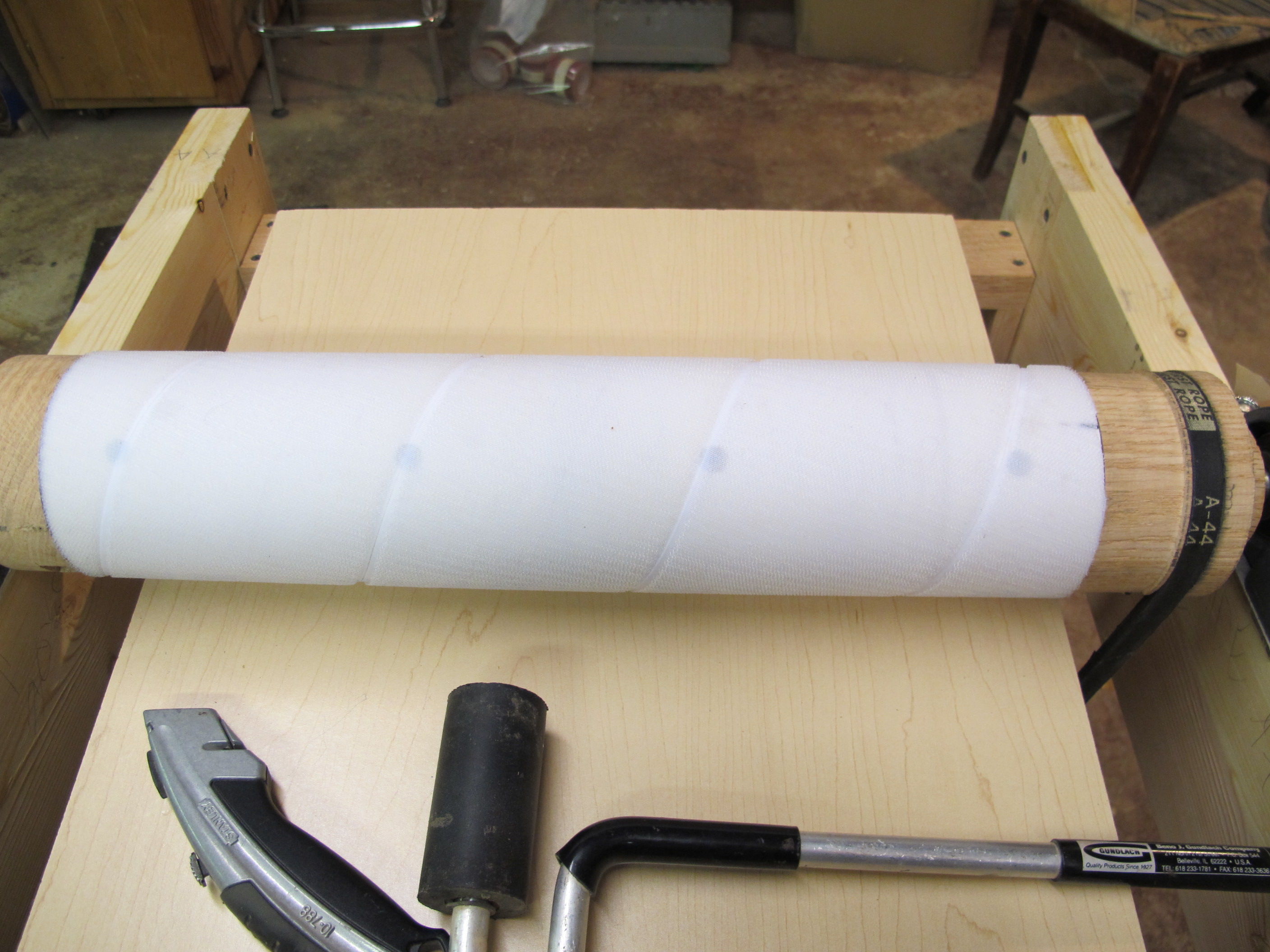
It was finally time to add the sand paper to the drum. Having decided on a Velcro (hook and loop) system, it was off to Super Grit http://www.supergrit.com/ . Their store is only a half an hour drive from here. The hook portion required 5 feet of material. This PSA stuff is 4” wide and is $2/foot. Also bought 3 different grits of the 3” wide loop paper. Their minimum purchase is 3 yards but at between $1.50 to $2.00 a yard it is reasonable. It took about 73” to wrap the drum but I think I can ge
lew
  • lew
The final major part of the assembly is the table. The piece of ¾” Melamine is from the scrap box at the local Vocational School and the piano hinges are pieces left from a project made for my brother in law. The top is reinforced with a frame of ¾” plywood on three sides and a 1” piece of oak on the hinge side. (top and bottom w hinge)       The hinge is then screwed to a mounting/adjusting bracket that fits between the two sides of the frame. A slotted hole
lew
  • lew
Time to mount the drum and motor to the frame. The choice of 2 x 6 sides was made to hopefully eliminate any flexing when work pieces were in contact with the sanding surface. However, that lead to difficulty in figuring out how to be able to mount the drum bearings to the sides. Long carriage bolts can be expensive! The sides are counter bored about 3” and then drilled to match the bolt diameter. An area around the mounting surface was mortised for an aluminum plate. The pillow block beari
lew
  • lew
Now that the drum runs true and the table lift works, it was time to start building the frame. My intention was to use mortise and tenon joinery but my choice of material was 2 x 6 for the top and bottom of the sides. This was larger than my mortiser could handle. I know, I could have chopped them out by hand. I opted for half lap joints. The overall width of the frame is 23” and the table height is about 31”. The length, at the bottom, is about 36”. The table is 16” x 24”. The frame is mad
lew
  • lew
After researching many sander designs and knowing my tendency to over engineer everything, there was only one choice for the table adjusting/lifting mechanism. The source of the lift came from this site and I give the author full credit- http://home.mchsi.com/~woodywrkng/DrumSander.html. The only change/addition I made was to add springs the help eliminate any “backlash” in the movement. The author of the site felt this mechanism gave more support over the full width of the table. The
lew
  • lew
After building the drum, a test was in order. After all, if this part didn’t run true there was no sense in moving forward. Using a piece of Corian, the motor and drum were clamped down in position. The motor is a 120v 1/3 HP motor salvaged out of our old furnace. The belt is the one from my table saw- a link belt replaced it.   (fire in the hole and Test 2)       With some anxiousness, power was applied. Holy Cow, It Worked!! The pulley ratio
lew
  • lew
When making my rolling pins, I use the thickness planer to bring the thin strips down to 1/8” thick. Unfortunately, if the grain in the wood is not uniform- or there are knots- the strips shatter. This wastes a lot of wood and doesn’t do the planer any good either. It seemed to me a thickness sander would be perfect for this process. Well, Craig’s List wasn’t producing any results and I couldn’t afford a new one. Time to take action!   Starting with what seemed to me to be the most cri
lew
  • lew

The Patriot Woodworker

A woodworking community built on craftsmanship, fellowship, and respect for those who serve. We proudly support our veterans and active-duty military members.

Forum Navigation

Community

United States Military Service Branches
© 2010 The Patriot Woodworker. All Rights Reserved.
Built on craftsmanship, integrity, and respect.

Account

Navigation

Search

Search

Configure browser push notifications

Chrome (Android)
  1. Tap the lock icon next to the address bar.
  2. Tap Permissions → Notifications.
  3. Adjust your preference.
Chrome (Desktop)
  1. Click the padlock icon in the address bar.
  2. Select Site settings.
  3. Find Notifications and adjust your preference.