Skip to content
View in the app

A better way to browse. Learn more.

The Patriot Woodworker

A full-screen app on your home screen with push notifications, badges and more.

To install this app on iOS and iPadOS
  1. Tap the Share icon in Safari
  2. Scroll the menu and tap Add to Home Screen.
  3. Tap Add in the top-right corner.
To install this app on Android
  1. Tap the 3-dot menu (⋮) in the top-right corner of the browser.
  2. Tap Add to Home screen or Install app.
  3. Confirm by tapping Install.
Supporting Our Service Members
We proudly stand with all United States service members in Operation Epic Fury and those deployed around the world. Your sacrifice, courage, and dedication are deeply respected and never forgotten.

General

Featured Entries

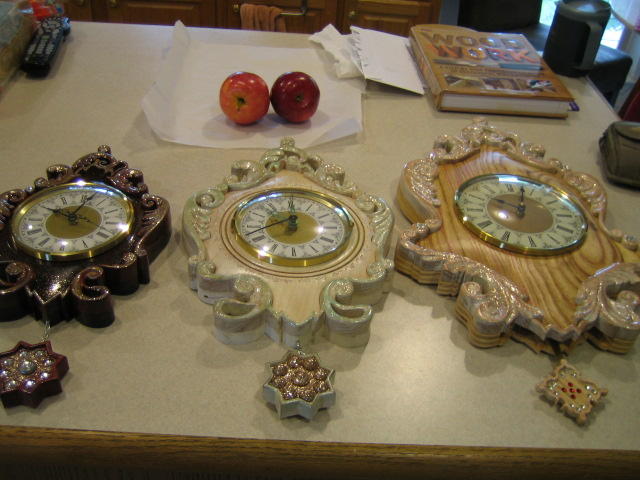
To start one needs a program like Rapid resizer then go to Pinterest... maybe like a few thousand flakes to choose from..  Find one you like and click on it to make it the largest size on the screen before you click on to Save as and here I use Documents to store this type of pictures.    Now you need a printer. No big deal here for I use for this is a Canon # 2522. About two or three months ago it was on sale  for less than 20 bucks.   Once the picture is stored in doc
Smallpatch
In Part #1, I mentioned that the pattern of the Celtic knot can be varied by how much wood is removed during the creation of the slots. Typically, I plow out a 3/8" wide slot and fill it with three inserts. That technique results in a pattern of knots that overlap-       If the slot is cut, leaving a center slice of wood intact, and then placing an insert on each side; the pattern displays diamonds at the cross-over-         Another subtle
lew
  • lew
I found it easier to glue if I oriented the blank with the diagonal cut facing up. I use an old restaurant cutting board as a gluing work surface and pieces of the cutting board as culls and pads. In this picture, you can see the three strips to be glued into place. They measure 2” x 10 3/4” x 1/8”. Test fit the pieces first to make sure they will seat into the slot. (I now have a thick piece of Corian countertop for the gluing surface)     On my first attempt, I didn’t use
lew
  • lew
Once the blank has the layout lines drawn, it is time to cut the slots for the ellipses. The first step is to set the blade height. When the cut is made, there should be about 3/32" to 1/8” of material left holding the two sides together. This is necessary during the glue up by keeping the pieces aligned.   Set the blank on the jig and adjust the angle and the end stop so that the front SHORTER layout line is positioned to the LEFT side of the blade cut. Orientation is
lew
  • lew
The second part will concentrate on the layout of the rolling pin blank in preparation for cutting the slots. Create a blank that is 22” long and 2” square.    Locate the center of the length (11”) and carry a line around the blank.   The ellipses are 11” long and made of three pieces of 1/8” thick material Layout a mark 5 ½” on either side of the centerline and accurately carry the lines around the blank.   To assist in laying out the diagona
lew
  • lew
This is a re-post on the Celtic Knot Rolling Pin. I am a fan of “Cook Book” style instructions so if I miss any details, please let me know and I will try to flesh them out. In addition, many of these photos/procedures have been refined over time and I will try to point them out by adding extra photos rather than rewriting the entire blog. I thought it best to start with the jigs I used to prepare the turning blanks. Please note that I always over engineer everything and hardly ever see the
lew
  • lew
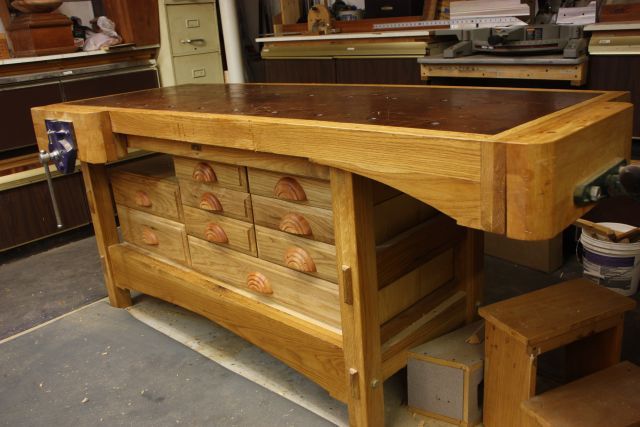
Where to start is to determine just what do you want to use the bench for. At the time for me it was flatwork and planing. I looked at many plans and decided on parts of several. Not sure where each part came from but the contributing plans were in Wood Magazine, Shop Notes and Popular Mechanics.   I started with the vices. Both are Lee Valley and maybe even paid full price. They are both front vices but one is mounted on the end. Next is to decide on the wood. I wanted White Oak and i
Gerald
Ok finally got a little time to continue. First lets talk about blast gates and routing boxes. I made these from plans in either Wood magazine or Shop Notes but did not write the issue on it. This gate is for individual tools or can be mounted in the duct . Basically this one is ply for sides and 1/8 masonite scrap for the blade. The plastic PVC connector is a piece of thinwall with about 1/2 inch cut out and then use PVC glue. This will allow the 4 inch flex to be attached.This could
Gerald
Now this may be getting the cart before the horse but lets call it collecting supplies you will need to connect your DC to machines. Thin wall PVC will work just fine . For the best you can order metal ducts any size you want but you will also have to buy expensive connections .   A consideration many people talk about is grounding the dust collector and duct. To my knowledge and every forum I have been on and every article and book "there has never been a explosion in a home workshop
Gerald
  • Gerald
Thought it might be best to start off with what my current setup is or at least parts of it. My Dust collector  is a Grizzly 1029 2 hp operating on 220v. It had a 5 micron bag top and bottom when purchased and was upgraded to a canister filter from Penn State. My collector is located in the attic of my shop in a insulated enclosure and a 12x24 filtered return to the shop. Power is controlled with a Long RAnger remote.    Ducting I used is 4 inch thinwall PVC. We will get into ducting a
Gerald
  • Gerald
So, I'm new to the site but I figured out that there is this nifty little blog feature.    I am a pyrographer. I burn designs into wood. It's amazing how relaxing it can be to create something so beautiful from something so potentially chaotic. Currently my works have been patriotic or pagan in genre. Eventually, as I gain more skill, I will branch into others as well.    I am more than happy to help answer any questions, to help you find the tools, etc.   
MaDeuce
this is not the same box but is the way I start building one.   I have to print out 10 exact patterns. The tenth one is just solid with no holes for drawers.     All the pieces  I cut out for the drawers are later glued together except for the front of the drawer and the back of the drawer. I use dowels to line up everything . If I don't use the dowels when clamping two pieces together it could slip just a hair one way or the other and cause lots of extra sanding or cause for the
Smallpatch
I ran across this picture and thought some who use patterns they buy with money, you just might save a few bucks.  I noticed home printers are getting about the price of a big hamburger so that shouldn't slow too many away from one.. I don't know how much the Rapid Resizer cost to have on your computer but it is sure helpful when needing to enlarge or reduce a picture to be used as a pattern...    This is the pattern that got me to carving wood and the patterns or I should say one pattern I
Smallpatch
Have to start with a glue up . Did not think I could find 6 x 6 dry pine so here we go with 3 pieces of 2 x 6. Tried to get the knots toward the surface outer edges as these would be turned off. Remember you can never have too many clamps                                     After squaring the blanks on table saw we will need a centered hole to assemble the two parts of the post as this lathe is not lon
Gerald
So with the koozie glued, there really isn't much left but the fun part.  I threw it on the lathe in my new oversized jaws and went to work.  I started slow, about 500 RPM because I didn't know how fast I could go with something this size.  Eventually I bumped it up to 800 and settled at about 1000RPM.  I used my Sorby roughing gouge to get it round (mainly because it is my favorite tool) and finished smooth with the circular carbide tip.  I also slightly rounded over the top lip and flattened t
Joe Candrilli
This was a stupid idea.   Sorry, that was wrong of me.  What I should have said was...   This was a REALLY stupid idea.   OK, in all seriousness, it is not THAT bad.  It is only about 200 segments the size of my pinky nail that have to be cut, sanded, and glued into 10 rings...per koozie.  I honestly found that I could get into a rhythm.  I would cut  one 1.5x.5x24 strip of oak into 3 strips, then cut those int segments.  Once the segments were cut I divided them in
Joe Candrilli
OK, so on to working the segments.  As I said, my goal is to complete a can koozie using segmented rings.  The best way I found was the 'wedgie sled' concept created by Jerry Bennett.  It is basically a 3 part sled.  I thought I could get away with just the adjustable arms and quickly figured out why the parts are there.  It is really a simple concept.  You adjust the 2 bars on the sled according to how many segments you want per ring.  You can do math (360 degree circle divided by 18 segments p
Joe Candrilli
Welcome back!   Before I roll into today's update please allow me to fill in the background story and update my tool list as per Mr John Morris' request.   I caught the woodworking bug back in 2014.  I have always wanted to be creative, but in all honesty I do not have that gene.  If you sat me in front of a canvas and asked me to create content I would fail.  I simply do not have the ability to take something from imagination and turn it to reality.  What I have found though
Joe Candrilli
I moved this post here, figured it was more appropriate as a blog vice a random post...   I figured this would be a great place to document my path down segmented turning.  That way we can all look back years later and laugh...   Today I will start with why I am looking at getting into segmented turning in the first place.  Last Christmas I was trying to figure out what to get my dad for a gift.  He is at the stage where there isn't much he needs, and I had already made him a
Joe Candrilli
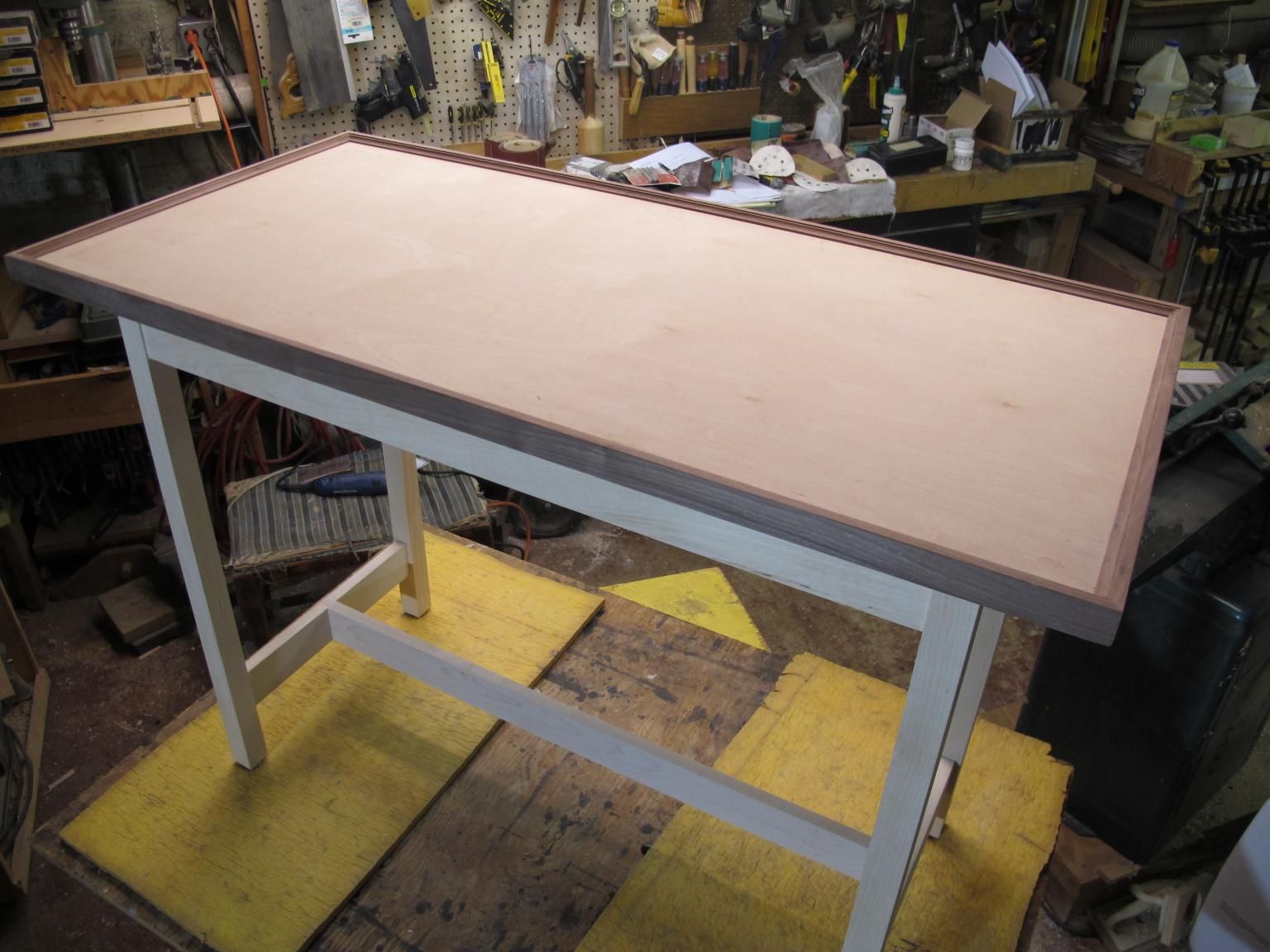
With the base finished, all that was left to do was trim out the top with the walnut edge trim. Glue, clamps and some pin nails.   I forgot to take photos of the top to apron mounting system but this Sketchup drawing should explain what I did. These are simple wooden clips with their tabs captured in slots that run around the perimeter of the inside of the aprons. The slot is 1/4" wide by 3/8" deep. The clips are cut from 3/4" thick maple and the tabs sized of a snug fit in the slots.
lew
  • lew
Once the legs were completed, I started on the aprons and stretchers. The stretchers are to be mortised and tenoned into the legs. The long stretcher needed to be securely fastened into the side stretcher but their thickness was only 3/4 ". That meant a very short tenon (1/2") on the ends of the long stretcher. I decided, mistakenly, to use a fox tenon and a dovetail style mortise, with tapered sides and wider at the bottom.     It took a little work to get the mortises chop
lew
  • lew
We left a very perfect size shop where we retired from. A  40x60  with a concrete floor.  So in thinking ahead with my lovely we won't need that much shop cause in our visions every road and highway is the U S was going to be our work shop.     Wild thinking but hey the very first 8 years of our last business we were open 7 days a week. Every day and even when it rained, we had many things to do.  From experience, so believe me when I say build a shop for 20 or 30 years down the r
Smallpatch
For such a simple table, this thing has run me through the funnies big time. Everything started out pretty good. The walnut trim, for the top, was made by multiple passes over several different router bits to get the desired profile.       It'll take a little sanding to smooth things out but I am happy with the results.   Next I turned to the legs. I milled down some 1 3/4" maple into 1 3/8" square blanks. Then laid out the locations of all of
lew
  • lew

Account

Navigation

Search

Search

Configure browser push notifications

Chrome (Android)
  1. Tap the lock icon next to the address bar.
  2. Tap Permissions → Notifications.
  3. Adjust your preference.
Chrome (Desktop)
  1. Click the padlock icon in the address bar.
  2. Select Site settings.
  3. Find Notifications and adjust your preference.