Skip to content
View in the app

A better way to browse. Learn more.

The Patriot Woodworker

A full-screen app on your home screen with push notifications, badges and more.

To install this app on iOS and iPadOS
  1. Tap the Share icon in Safari
  2. Scroll the menu and tap Add to Home Screen.
  3. Tap Add in the top-right corner.
To install this app on Android
  1. Tap the 3-dot menu (⋮) in the top-right corner of the browser.
  2. Tap Add to Home screen or Install app.
  3. Confirm by tapping Install.
Supporting Our Service Members
We proudly stand with all United States service members in Operation Epic Fury and those deployed around the world. Your sacrifice, courage, and dedication are deeply respected and never forgotten.

General

Featured Entries

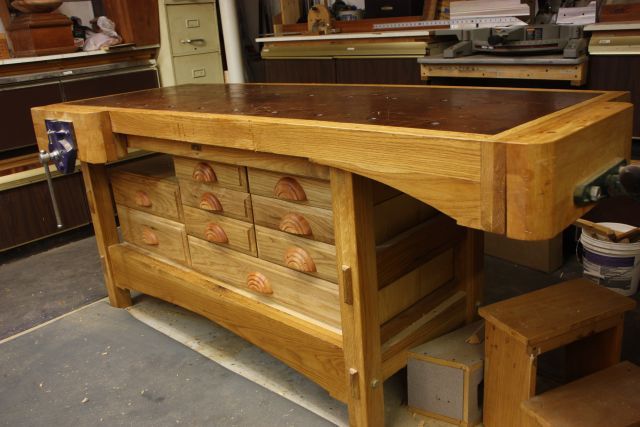
Part 2: This build was not going to be particularly difficult. My biggest concern was the maple top. I’ve built smaller edge grain tops before so the process was not unfamiliar; however, the staggered shorter length field pieces had me scratching my head about clamping and gluing. Also, I needed to consider the size of the top versus the capabilities of my shop equipment. My Dewalt 735 planer maxes out at around 13” wide and my little shop made drum sander can only handle very small work.
lew
  • lew
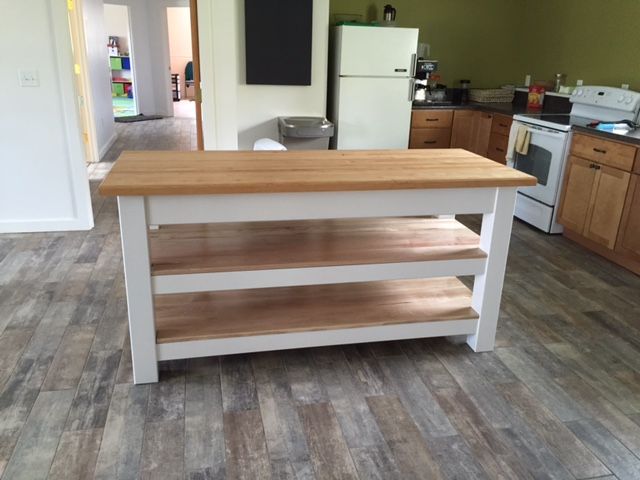
The Pastor’s Table or I Think My Sister Is Trying To Buy My Way Into Heaven -  (borrowing a title concept from Rocky and Bullwinkle) Part 1: I think my sister believes my past transgression’s slate can be, at least in part, wiped clean by building furniture for the church she attends. The latest installment is a kitchen island/work table for the church’s kitchen. The pastor emailed me a picture of a table he thought would work but wanted something larger and with slightly di
lew
  • lew
Well we left off with our veterans appreciation plaques sanded to 150 in the last blog, and here we are with some images that will bring us to the completion of the project. After I sanded all the awards to 150 I continued on through the grits up to 600, I was happy with the burnished sheen the plaques were developing. And I decided enough was enough, time for some finish! I would typically mix my own wipe on oil, but I had a can of Watco Danish Oil sitting around and decided to use it, and not
John Morris
    My name is John Morris, and I am the founder of The Patriot Woodworker. Our community was founded on the principles of sharing, mentoring, and learning from fellow woodworkers, and above all, we have one thing in common, we all support the men and women who serve our nation. And we pretty much take on any task or challenge for our veterans that is asked of us, with the help of our sponsors. &
John Morris
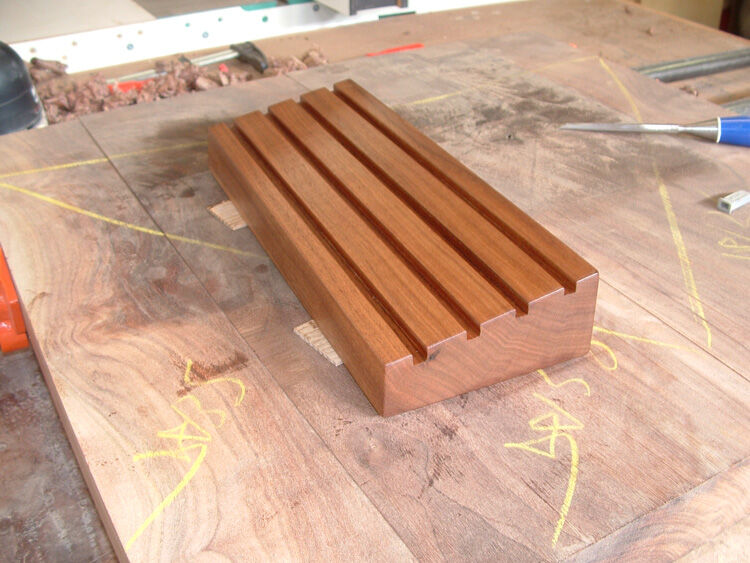
Thank you for joining us. Below is the Military Challenge Coin Display as described by The Patriot Woodworker network. This is a design that we drew up with the help of designs seen all over the web, it is easy to build, most folks have the tools that are necessary to build it, and the finishing process is quite simple. If you don't have the tools that I am using, your sure to find a way around that, as this is as I said, very simple to build. This basic display is 12" long, 4 1/2" deep, 1 1/8"
Courtland
The final installment of this project is just a little follow-up on the last details. My friend supplied the hardware and liner for me to install. The latches snap securely and installed easily, as did the hinges. The only caveat was that the sides of the case were 1/2" thick and the screws were a little longer. The difference isn't noticeable due to the type of liner he chose. The short protruding nibs actually help keep the foam in place.   I had never worked w
lew
  • lew
Once everything was properly fitted, the case was disassembled and prepped for gluing. I had previously sanded all of the pieces to 150 grit- except the top and bottom. Those two were sanded to 220 grit due to the difficulty of sanding them in place. I taped the locations where the dovetails intersected- on the inside of the box- to help eliminate a lot of glue squeeze out cleanup. Assembled one end and two sides. Dropped in the top and bottom. Then glued in the last end piece. Some clamps, chec
lew
  • lew
Having solved the problem of the non-supported dovetails in the lid, I made a dry fit of the sides and ends Most often, I like to make actual measurements rather than rely on what I calculated the size of the pieces I'll need. The good old Stanley Folder is my go-to tool for this type of measurement. Once the dimensions are taken, I can size and create the top and bottom. Both pieces were made from glue-ups. The top is 1/2" stock. The bottom is created from
lew
  • lew
The sides and ends needed to have dados to accept the top and bottom. So as not to have the dados extend through the pins, stopped dados would do the trick. These were made on the router table. 1/4" wide and 5/16" deep. It was time for a little finessing of the joints to assure everything fit. Yes, there it was staring me right in the face! How could I not see what I did. Worse yet, how am I going to fix it now?!?!?!? I picked up the test piece and it finally hit me! I
lew
  • lew
After milling and sizing the sides and ends, it was time to layout the dovetails. I use a shop made angle layout jig for the tails. I'm a tails first dovetail person. I know there are folks who do the pins first and there are valid arguments to each procedure. This is how I learned to do them and it works for me. I use a marking knife for laying out the dovetails and a marking gauge to locate the dept of cuts. As for cutting the the dovetails, I really like the Japane
lew
  • lew
While I was building the humidor, a friend mentioned he had acquired a shotgun. He wanted a protective case but not the typical soft sided type.  We measured his gun and calculated what size the case it would take. Not too large but enough room for a couple of accessories. Using Sketchup, we eventually came up with an appropriate design. While he hadn't decided on the hardware, I now had enough information to begin working. The box is solid walnut with inside dimension
lew
  • lew

Account

Navigation

Search

Search

Configure browser push notifications

Chrome (Android)
  1. Tap the lock icon next to the address bar.
  2. Tap Permissions → Notifications.
  3. Adjust your preference.
Chrome (Desktop)
  1. Click the padlock icon in the address bar.
  2. Select Site settings.
  3. Find Notifications and adjust your preference.