Search the Community
Showing results for tags 'hand tools'.
-
Have ya'll heard of Jim Bode Tools, ya, pretty cool. They are advertised in the MWTCA Gristmill. Have fun! https://www.jimbodetools.com/collections/whats-new
-
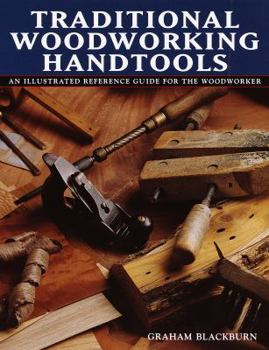
I'm (re-reading) this book a chapter at a time. Each of the 50 chapters covers a specific hand tool in quite some depth (8-12 pages). Hundreds of hand-drawn illustrations. If you want to know something about a specific tool (or learn about them all), this is the one. Many of the topics appear to have been published in various magazines as a recurring column. Graham has written a number of books and now has a YouTube channel that is similar -- a short video on a specific topic. Currently about 87 episodes https://www.youtube.com/@gjbmunc Graham self-published the book but it appears to only available on the secondary (used) market right now. I first "met" Graham online in the late 1990s when the book first came out and somehow he found me and I shared his book with a hand tool group that I was active in at the time. At that time, he was in Woodstock, NY. Coincidentally, he played in a band that performed at the famous Woodstock event. A few years later, I was helping out as a host at a Popular Woodworking conference here in town and coincidentally, I hosted one of Graham's sessions. I was shocked that he remembered me.

-
If any of you are interested in hand tools and methods, there is a YouTube channel with a bunch (80+) short videos on methods and tools. I have Graham's book and met him in person a few years ago. One interesting thing is that he also played guitar at Woodstock in 1969. https://www.youtube.com/@gjbmunc
-
 Instructions Welcome to our Glossary of Woodworking Hand Tools. Feel free to edit and add "Hand Tools" to this research page. Please follow the general guidelines as outlined below. Add only woodworking terminology that is widely used in the crafts, arts, trades and industry of woodworking. Avoid entering terminology that is used locally, or regionally. Please research your own entries, before entering them here, and verify that they are indeed accurate and reliable. A Adze - An adze is similar to an axe, imagine an axe with its blade at a right angle to its haft (helve or handle). See various types below See various types below: Adze, Carpenters - This adze similar to the standard adze, yet has a square back of the blade, that can be used for striking other object as in a hammer or maul action. Adze, Coopers - The coopers adze is held by one hand and has a curved blade, typically used by barrel makers, favored for its small and easy to use weight and size, and for the curved blade. Adze, Sculptors - The sculptors adze has a straighter blade quite the opposite of the coopers adze, it as well is used by one hand. Adze, Ship Carpenters - This specialty adze has a blade similar to the shape of a garden hoe, and is fitted with a spur on the back of the blade, the spur is used to set large nails or to punch holes or indentations into the wood. Axe - See various types below: Broad - The Broad Axe is suitable for squaring logs and planks, for example when building a log house. Broad Axes very greatly depending on the shape of the head and edge and the angle of the handle. Carpenters - Carpenter's Axe or Carpenter's Hatchet is a small axe, usually slightly larger than a hatchet, used in traditional woodwork, joinery and log-building. It has a pronounced beard and finger notch to allow a "choked" grip for precise control. The poll is generally designed for use as a hammer. Newer carpenter's hatchets will often have a groove for pulling nails as well.2 Carving - The carving axe is the smaller of the other axe types. Used for rough shaping of smaller timbers and logs. The handle of the carving axe is roughly the same length of most hammer handles, and may have a pronounced curve in the handle from the lug of the axe head to the knob of the handle. This type of axe is popular among green woodworkers for it's agility in shaping and even paring down wood for final shaping in skilled hands. Felling - Used for cutting down trees, the felling axe has an extremely sharp blade or (bit) with a slightly tapered head. The average head weight of a felling axe is between 2.5 to 3.5 lbs. The tapered head and sharp bit allow for cutting across the wood grain, and deeply with each strike by the user. Hand - To put it shortly, a hand axe is roughly twice the length and weight of a hatchet. The hand axe handle is typically at a 90 degree angle to the head. While the hatchet handle is generally curved. The hand axe is an all purpose axe popular at campsites and for general chopping and size reduction of wood. A true hand axe is used by the hand and has its origins in pre-historic time periods. The head of the hand axe is gripped directly by one or two hands. It is the longest-used tool in human history and was typically "made of flint, but rhyolites, phonolites, quartzites and other coarse rocks were used as well. Obsidian, natural volcanic glass, shatters easily and was rarely used." 3 Hatchet - Hatchets are used chiefly by carpenters in shingling and lathing. They have a short handle and can be used both for cutting and nailing. Mortising - Used for cutting mortise or tenon joints for log and timber housing and structures. Splitting - Splitting Axe can be used for splitting all types of firewood. It is forged and ground to a concave, quite thin blade at the bit. The axe cuts quickly and easily into the wood and then effectively splits it as the broader section pushes apart the wood. Awl - A tool used for puncturing a small hole in wood, typically used for a starting guide prior to drilling a hole in the wood. The drill bit will be guided by the small puncture the awl creates. B Bench - The bench is a tool or appliance of the utmost importance to the woodworker. The best type of bench has a top that is constructed of narrow strips of hard wood, glued and bolted together. It usually has a recess or trough in which tools may be placed while working. The top is bolted to a frame consisting of four legs braced securely with cross-pieces. This frame is often fitted with one or more drawers. See various types below. Danish - European - Roubo - The Roubo workbench is a design created and used by Andre Jacob Roubo who was a carpenter, designer, and author, born and died in Paris, France (1739 - 1791). The bench designed by Roubo has been copied for modern day use and woodworkers use design elements of his bench to incorporate into their own benches. An excellent example of a modern day Roubo Bench by woodworker Kari Hultman. Brace - See various types below: Bit brace extension - A bit-brace extension is a steel rod having a small chuck on one end and a square shank like a bit on the other. A bit, 5/8 in. or more in diameter, is inserted into the chuck of the extension, and this in turn into the chuck of the brace. The smallest hole that can be bored with this tool measures 5/8 in. Bit-brace extensions are made from 12 to 21 in. in length. The smallest hole that can be bored with the larger size measures 3/4 in. Plain brace - The plain brace is a tool used for holding a bit securely while boring a hole. At one end the brace has a chuck for clamping the bit, at the other, a knob. The handle of the brace is shaped like a crank. Ratchet brace - The ratchet brace is fitted with an attachment which permits boring in places where a complete turn cannot be made. The size of braces is given according to the sweep; i.e., the diameter of the circle that the handle makes in a complete revolution. Boring - See various types below: Auger bit - Auger bits are screw shaped tools consisting of two main parts, the twist and the shank. The twist ends in two sharp points, the nibs or spurs, which score the circle, and two cutting edges, the lips, which remove the shavings from within the scored circle. A small screw point, in the center of the cutting end, centers the bit and draws it into the wood. Auger bit gauge - Auger-bit gauges of different types can be fastened to auger bits, and adjusted so that only holes of certain depths are bored.. Dowel bit - Dowel bits are short auger bits 4 1/2 in. long over-all. Ordinary auger bits up to 1 in. diameter are from 7 to 9 in. long over-all. Car bit - Car bits and ship augers are auger bits from 18 to 24 in. in length. Expansion bit - Expansion bits have a movable cutter, which is adjustable to bore holes of different diameters. Expansion bits are made in two sizes. The largest size has three cutters, and bores holes up to 4 in. in diameter. Gimlet bit - A gimlet is a hand tool for drilling small holes, mainly in wood, without splitting. It was defined in Joseph Gwilt's Architecture (1859) as "a piece of steel of a semi-cylindrical form, hollow on one side, having a cross handle at one end and a worm or screw at the other". Gimlet bits are used for boring holes of small diameters such as are needed when inserting screws in hard wood. Their size, which varies from 1/16 to 3/8 in. by thirty-seconds, is stamped on the tang. Twist bit - Twist bits are shaped just like the familiar twist drill, except that they have a steeper cutting angle and a square tang. They range in size from 1/16 to 5/8 in. by thirty-seconds. Twist bits can be used for wood only, while twist drills can be used for both wood and metal. Forstner bit- Forstner bits have no twist and no spur. They cut with a sharp circular steel rim and two lips within this rim. They bore very accurately, and are especially useful for boring thin wood and for end-wood boring. Their sizes are stamped on the tangs in sixteenths of an inch. Brad Awl - The bradawl has the appearance of a small screw driver. It is used for making holes into wood for screws and nails. The hole is produced by forcing the awl into the wood with a twisting motion. It should not be used in thin wood nor too near the edge. Rose Countersink - The countersink is a small, cone-shaped tool used for widening the end of holes bored for flat-head screws. One type can be opened and sharpened on an oil-stone. C Calipers - See various types below: Calipers inside - The inside calipers are used to measure the internal size of an object. Calipers outside - The outside calipers are used to measure the external size of an object. Dial - Dial calipers are normally used for measuring the thickness of materials and small amounts of movement. They are especially popular for automotive and machining applications. There are two sets of graduations on a dial caliper. The main scale is marked in one-tenth (0.1) inch intervals. Digital - Digital calipers measure the outside dimensions of a work-piece or feature. They have adjustable jaws that slide along a beam with an LCD that displays measurements without requiring interpretation. Jenny - Fixed point 'Jenny' calipers are specifically designed to locate the center of a round or square section of material, and are also used for marking off a constant distance from an edge. One leg holds an adjustable point and the other leg features a locating lug. Spring joint - A caliper having legs fastened together with a spring and pivot at the top joint. Vernier - Similar to the Digital caliper except the reading is on a vernier sliding scale instead of a digital read. Chisel - According to their construction, chisels may be divided into two general classes: tang chisels, in which part of the chisel enters the handle, and socket chisels, in which the handle enters into a part of the chisel. See various types below: Bevel edge - Butt - The butt chisel differs from the others only in that it has a shorter blade and, therefore, can be used in more inaccessible places. Carving - Corner - Dovetail - Firmer - The firmer chisel which is said to get its name from the fact that it is firmer or stiffer than the paring-chisel. The firmer-chisel is a general utility tool, being suited for hand pressure or mallet pounding, for paring or for light mortising. Flooring - Framing - The framing chisel has a very heavy and strong blade, and is used in rough carpentry work and shipbuilding. Mortise - The mortise chisel, as its name implies, is used for chiseling mortises. It is, therefore, very thick just below the handle so that it will not break when it is used as a lever in forcing the shavings out of the mortise. Paring - The paring chisel, which has a slender blade, is used mainly for hand chiseling. This type of chisel usually is beveled along the sides, so that fine work can be done, such as reeding which requires an extra-thin blade. Skew - Socket - Socket mortise - Tang paring - Clamp - See various types below: Steel bar - Steel bar clamps consist of a steel beam or bar fitted with a screw and crank at one end, and a steel head which can be moved along the bar and fastened to it by means of slots cut into its lower edge at short intervals. Steel bar clamps are made in lengths of 2', 2' 6", 3', 4', 5', 6', 7', and 8 ft. C - C clamps, or screw clamps, sometimes called "carriage-maker's clamps," consist of a malleable-iron frame, bent in the shape of the letter C, and a steel screw with a swivel tip. They are made in sizes, which, when open, measure from 3 to 12 in. Column - Column clamps consist of a steel chain and a right and left screw. They are very useful when gluing together polygons, shaped columns, and any circular work such as the apron for a round table. Hand screw - Hand screws are most useful both in clamping up finished work and in holding work under construction. They consist of two jaws made of hard wood and two steel spindles, the end and middle spindles. They are opened or closed by grasping a handle in each hand and revolving the hand screw. The size of a hand screw is indicated by the length of the jaw in inches, the smallest being 6 in. and the largest 18 in. D Dividers/Compass - Entry needed Draw Knife - The drawknife is used for rough cutting, especially on edges, both straight and curved. It is a tool with a long blade whose cutting edge is on the side. At each end of the blade is a handle. The operator grips the handles and draws the knife toward him. F File - See various types below: Flat - Half round - Round - Froe - A froe (or frow) or shake axe is a tool for cleaving wood by splitting it along the grain. It is an L-shaped tool, used by hammering one edge of its blade into the end of a piece of wood in the direction of the grain, then twisting the blade in the wood by rotating the haft (handle). H Hammer - See various types below: Claw - The claw hammer is the type of hammer generally used by carpenters and woodworkers. The peen of this hammer is bent and shaped so that it can be used for pulling nails. The face of the hammer often is slightly convex, or bell-faced, so that it will not make a circular mark on the surface of the wood after striking the last blow on the head of a nail. It is important to keep the face of the hammer clean and free from grease or glue, so that it will not glance off the head of a nail and bend it. The size of the hammer is indicated by the weight of the head in pounds and ounces. Ball Pein - A ball-pein hammer, also known as a machinist's hammer, is a type of peening hammer used in metalworking. It is distinguished from a cross-peen hammer, diagonal-peen hammer, point-peen hammer, or chisel-peen hammer by having a hemispherical head. It is commonly used as a tool for metalworking. Cross and Straight Pein - These hammers have a wedge-shaped head instead of a ball-shaped head. This wedge shape spreads the metal perpendicular to the edge of the head. The straight-peen hammer has the wedge oriented parallel to the hammer's handle, while the cross-peen hammer's wedge is oriented perpendicular.5 Club - Sledge - Joiner's Mallet - Mallets are wooden hammers. As wood is more elastic than iron or steel, a mallet should always be used when driving on wood. The blows of a steel hammer would soon splinter a chisel handle and mar a joint to be driven together beyond repair. Soft-faced - Handsaw - See various types below: Ripsaw - The ripsaw is used for ripping or cutting with the grain along the straight line. Blades of ripsaws vary in length from 20 to 28 in. They are always wider at the handle than at the end, in order to prevent them from bending or buckling when they are pushed through the wood. Crosscut saw - The crosscut saw is similar in shape and appearance to the ripsaw. The only difference lies in the shape of the teeth, which are filed to a point instead of square across as on a ripsaw. The number of points to the inch varies from 8 to 12. Backsaw - The backsaw is a crosscut saw wtih a thin blade and fine teeth. A heavy piece of steel fitted over the back of the thin blade prevents it from buckling. The blades of backsaws are from 8 to 18 in. long. Backsaws are used for finer work such as cheek and shoulder cuts on tenons. Dovetail saw - The dovetail saw is shaped like a backsaw, but has thinner, narrower blade and finer teeth. The handle of a dovetail saw is shaped like a chisel handle. The length of the blade varies from 6 to 12 in. It is used for extremely fine work such as cutting of dovetails. Compass saw - shaped like a ripsaw, but its blade is so narrow that it can cut on curved line. It is particularly useful in cutting a section from within a board or panel. A hole is bored near the line to be cut and the pointed end of the saw inserted into this hole. Keyhole saw - is a smaller and finer compass saw. Tenon saw - The tenon saw has a higher blade body in the back-saw class of saws. It's stout and firm blade allows deep cuts for joinery and prevents binding in the material. The Tenon saw is often used as a carcass saw. Turning saw - consists of a very narrow blade, about 3/16 in. wide, which is held under tension in a frame. It has ripsaw teeth and is used for cutting curves, as the blade usually can be revolved in the frame. It can also be set in the frame so that it cuts either on the pulling or the pushing stroke. Hack saw - is not properly a woodworker's tool, but is often a very convenient tool to have in the shop. It has a narrow blade set in a long, narrow metal frame, and is used for cutting metals. Coping saw - is a very small turning saw usually having a metal frame. It is used for sawing fretwork patterns and coping moldings. L Lathe - See various types below: Spring pole lathe - A reciprocating lathe that uses a springy pole to return the treadle and drive cord to the start position for the power stroke. Usually, the lathe consists of a track or "bed" that carries two movable "puppets" that support conical centers that poke into the ends of the turning wood and define the axis of rotation. The drive cord attaches to the free end of the spring pole, wraps around the work and then down to the foot treadle. The turner cuts the spinning wood on the down-stroke of the treadle and then allows the spring pole to lift it back up. Treadle lathe - Level - Used for checking vertical surfaces for plumb or horizontal surfaces for level. Typically a straight solid piece of wood or metal, or plastic, with one or multiple vials full of a liquid, and a bubble that will visually indicate if the surface is level or plumb. M Marking gauge - See various types below: Gauge butt - differs from a mortising gauge in that its spurs are at extreme ends of the beams. It can, therefore, be used in internal corners such as door jamb when gauging for the width of the hinges. It is made of steel and has three spurs. Gauge marking - made of wood or steel. The one most commonly used consists of a square, wooden bar or beam, about 8 in. long, on which a wooden block or head slides. This block can be fastened at any point of the bar by means of a brass set-screw bearing against a brass shoe. The block, on the best grade of gauge, is protected from wear by a piece of brass set flush with its surface. The bar is graduated in inches and provided with a steel point or spur fastened near the end with a screw. The spur must be filed to a fine point. This tool is used for marking or gauging widths on narrow pieces of wood, such as table legs, etc. When using it. move the gauge away from you, and tip is slightly forward, keeping the block in contact with the edge or face of the board at all times. Gauge mortising - is a marking gauge with two spurs, which can be spaced at different distances and mark two parallel lines at the same time. One type is made of rosewood and has and adjusting screw in the end of the beam, which moves one of the points up or down the as desired. The other side of the beam is fitted with a single point as an ordinary marking gauge. This gauge is used chiefly for layout out mortises and tenons. Other types are made entirely of metal and have two bars. Gauge slitting - is similar to the panel gauge, but has a handle in addition to the block. It has a knife instead of a spur and is used for cutting thin stock. Measuring tape - Used by carpenters, contractors, and architects. They are made of steel or cloth, and usually measure from 25 to 100 ft. in length. They are divided into inches and feet, or meters and centimeters. Miter box - Entry needed Miter and try-square - can be used at both 90 and 45 degrees. Miter squares can only be used for angles of 45 degrees. N Nail set - Nail sets are small steel bars about 4 to 5 in. long and 1/4" in diameter. They have a cup-shaped point, and are used to set nails below the surface. The size of the point varies with the size of the nail to be set. P Planes - See various types below: Jack plane - A jack plane is a general-purpose woodworking bench plane, used for dressing timber down to the correct size in preparation for truing and/or edge jointing. It is usually the first plane used on rough stock, but in exceptional cases can be preceded by the scrub plane. Fore plane - The fore plane is built exactly like a jack plane, but is 18 in. long and has a plane iron 2 in. wide. Jointer plane - The jointer is also like the jack plane, but is 22 to 24 in. long, and has a plane iron 2 3/8 in. or 2 5/8 in. wide. The latter two planes are used for leveling larger surfaces and for jointing the edges of boards to be glued. Smooth plane - The smooth plane is of the same construction as the above named planes, but it is shorter, being from 5 1/2 in. to 10 in. in length. Circular plane - The circular plane differs from the others in that it has a flexible bottom 10 in. long, which can be adjusted to either convex or concave curves. It is used on curved work, such as round table tops and aprons. Block plane - The block plane is a small plane from 4 to 8 in. long. It has only a single plane iron, which is placed at a very low angle with the beveled side up. The lever cap is generally curved so that it fits smoothly within the hollow of the hand. This plane is used for planing end wood and in places where an ordinary plane could not be used. Bullnose plane - The bullnose rabbet plane is about 4 in. long, and has the plane iron fastened to the extreme front of the body. Rabbet and Fillister plane - The rabbet and fillister plane is an iron plane used for planing grooves or rabbets on the edges of a board. It has both a depth and a width gauge, as well as a spur, which scores the wood in advance of the plane iron, thereby preventing splitting. Dado plane - A dado plane is similar to a rabbet plane, but is used for cutting across the grain. Match plane - A matching plane is used for matching boards; i.e., plowing a groove on the edge of one and a tongue on the edge of the other. It has two cutters, a plow and a tongue cutter. Router plane - The router plane is used for removing the wood between two sawed or chiseled edges such as dadoes or grooves. The plane iron is lowered after each cut. It is furnished with a 1/4 in., a 2 1/5 in., and a smoothing cutter. Universal plane - The universal plane is a very complicated piece of apparatus for planing moldings, dadoes, beads, flutes, etc. It is furnished with as many as 53 different cutters. Molding planes - Molding planes are wooden planes, having but one plane iron for one particular type of molding. Wooden planes of all types are still used a great deal, especially by European cabinetmakers and carpenters. The inexperienced worker finds them more difficult to adjust, but they have certain advantages over the iron planes. One of these is lighter weight, which is especially noticeable on jointer planes, and another is that shavings from resinous woods do not stick to their bottoms. Plane gauge - Plane gauges are made both for iron and wooden planes. They can be attached to the sides of smooth, jack, fore, or jointer planes, and enable the operator to plane bevels or chamfers of any angle on the edge of a board without the continuous use of a bevel or try-square. Plumb bob - A plumb bob, or plummet, is a weight, usually with a pointed tip on the bottom, suspended from a string and used as a vertical reference line, or plumb-line. It is essentially the vertical equivalent of a "water level". R Rasps - See various types below: Wood - Metal - Ceramic and Glass - Rifflers - See various types below: Die sinker - Silversmith - Rule - Rules are made in different lengths and of different materials. Those used by woodworkers are usually of the folding type, and measure from 2 to 8 feet in length. Rules are generally marked off on both sides in inches and subdivisions of an inch, but they are also made with such divisions on one side and metric divisions on the other. S Scraper - Scrapers are of two kinds; those sharpened like a plane iron and held in an iron frame or plane body, and those that have square edges and are held in the hand only. The first class is called ''cabinet scrapers" or "scraper planes," and the last type is called "hand scrapers." Hand scrapers having curved edges are called "molding scrapers." Scrapers are used for smoothing a surface after it has been planed. Cross-grained and highly figured woods must always be scraped. Card Scraper - A card scraper is a woodworking shaping and finishing tool. It is used to manually remove small amounts of material and excels in tricky grain areas where hand planes would cause tear out. Card scrapers are most suitable for working with hardwoods, and can be used instead of sandpaper. Scraping produces a cleaner surface than sanding; it does not clog the pores of the wood with dust, and does not leave a fuzz of torn fibers, as even the finest abrasives will do. Screwdriver - A screwdriver is a tool, manual or powered, for screwing and unscrewing screws. A typical simple screwdriver has a handle and a shaft, ending in a tip the user puts into the screw head before turning the handle. The shaft is usually made of tough steel to resist bending or twisting. The screwdriver, which began to appear regularly on the woodworker's bench after 1800, did not share the long evolution and tradition of other Anglo-American tool designs. The screwdriver in its early versions frequently had a scalloped blade for no other purpose than decoration. See various types below: Phillips - In the early 1930s, the Phillips head screw was invented by Henry Phillips. Automobile manufacturers now used car assembly lines. They needed screws that could take greater torque and could provide tighter fastenings. The Phillips head screw was compatible with the automated screwdrivers used in assembly line. Slotted - Around the first century CE, screw-shaped tools became common, however, historians do not know who invented the first. Early screws were made from wood and were used in wine presses, olive oil presses, and for pressing clothes. Metal screws and nuts used to fasten two objects together first appeared in the fifteenth century. The heads on these types of screws have one slot for the driver to engage. Shave horse - A shaving horse is a combination of vice and workbench, used for green woodworking. Typical usage of the shaving horse is to create a round profile along a square piece, such as for a chair leg or to prepare a work piece for the pole lathe. They are used in crafts such as coopering and bowery. Sliding T bevel - are similar to try-squares, but differ in that their blades are adjustable to any angle. They are used for laying out angles other than right angles, as for instance, corners braces, dovetails, or side rails for chairs. Spoke shave - The spokeshave is like a plane with a very short bottom. It is, therefore, suitable for smoothing curves that are too small for a circular spokeshave plane. Spokeshaves are made in many patterns, generally with an iron body. One type, the patternmaker's spokeshave, is made of wood. Saw - In woodworking and carpentry, hand saws are used to cut pieces of wood into different shapes. This is usually done in order to join the pieces together. They usually operate by having a series of sharp points of some substance that is harder than the wood being cut. See various types below: Back saw - A back saw is any saw that that thick metal rib on the opposing edge of the cutting edge. The purpose is to stiffen the blade and to provide better control of the cut. Bow saw - A modern bow saw is a metal-framed crosscut saw in the shape of a bow with a coarse wide blade. This type of saw is also known as a Swede saw, Finn saw or bucksaw. It is a rough tool that can be used for cross-cutting branches or firewood, up to six inches (150 mm) in diameter. The name 'Swede saw' probably derived from the ovate metal tubular frame version, invented in the 1920s by the Swedish company Sandvikens Jernverk, and additional patents by two Swedish immigrants to the US. Modern versions all share those common features. 11 Buck saw - Coping saw - Cross cut saw - Dovetail saw - Fret saw - Hacksaw - Japanese saw - Keyhole saw - Rip saw - Turning saw - Veneer saw - T Trammel points - Try-square - Used for testing the squareness of lumber, and in checking the squareness of work being assembled, especially in places where a framing square would be too large. Try-squares consist of two parts, the stock and the blade, which are firmly fastened together at right angles. The stock is thick and made of wood or iron. The blade, which is thin, is made of steel and has an inch scale stamped on it. Try-squares are made in sizes from 4 to 12 in., measured from the end of the blade to the stock.
 -
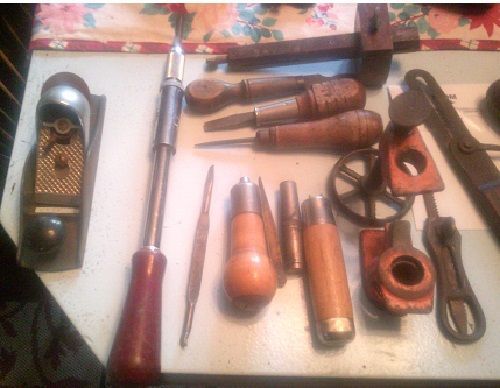
Thursday...a large, HEAVY box appeared on my front porch....opened it up, and spread the contents out, a bit..took up half the table's top...but.. The Ring? Goes on a finger, then you pull a strip of leather through..cutting a strip that you can adjust the width of... Guide Bushings, Craftsman router... A little bit of everything... That saw blade gave me a poke, during the un-wrapping.. C clamps, anyone? and a few squares..so...today's task was to clean and sharpen..and repaint as needed.... What had looked like a pair of tweezers was a solid brass pair of dividers 4" Tear the bevel gauge all the way down..shine up the brass fittings, shine the steel parts up...straighten the blade..give the sanded wood a wipe down with oil. Squares? Bottom one was from Henry Disston & Sons No.1, 6" try square..not too sure about the other 2..top one was a rusty mess...that is not the smallest block plane in the till..but very close to it. These look any better? No. 67 is now SHARP, Block plane is too..Turnscrew looks better,All metal square is a Stanley SW 6" Miter square..and as for that rusty double Spokeshave? Wire wheel clean, gloss black paint, both irons sharpened and set..Under the handle, and under the two cap irons is the No. 60...Early model Stanley? Saw has E.C. Atkins stamped on the blade. Depth adjuster on that block plane is NOT gray plastic...but a type of cast metal. The orange clamp is from PONY...and needs a bit of 1/2" pipe. The Craftsman Handle? Is to hold files and such. That metal cylinder, is hollow, and has couple of bits inside...that fit into a slot...in one case, it becomes a t handled Gimlet Drill...Those are not tweezers, that is the Brass 4" dividers...Not sure about the fat body handle..yet Unscrew the butt end, until a file will fit inside, then tighten things up. Holds the file securely.. First half is done...start on the other half, tomorrow? Stay tuned
- 13 replies
-
- 12
-

-
- hand tools
- rehab
- (and 1 more)
-
-
- 1
-
-
- barrel making
- hand tools
- (and 4 more)
-
I just found out that Blue Spruce Toolworks is now a part of Woodpeckers, and apparently has been since 2020. I thought they were still separate companies. I have the same question as some others I read on line. Is Blue Spruce still making their own tools, or has that been folded into the Woodpeckers mass production facility. I have no problem with Woodpeckers tools. They are some good and sometimes quite innovative tools, if not somewhat over priced. Blue Spruce tools are also expensive, but you can forgive that when you consider they are handmade. But are they still handmade?
- 20 replies
-
- 4
-
-
- blue spruce
- merged
- (and 2 more)
-
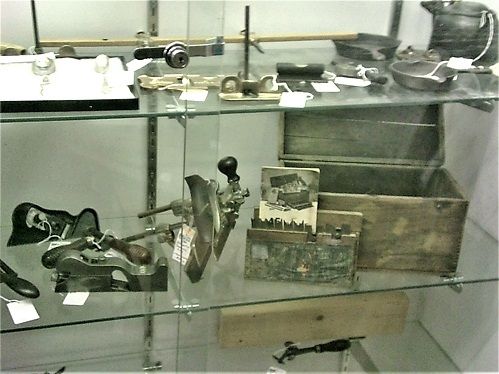
Decided on a bit of "Me Time" a while back....and drove down to Springfield, OH. to raid a couple places....One was "Heart of Ohio Antique Center" out in Harmony, OH. Cheap saw was $50? the other was $80..pass Red circled item..A Stanley No. 46....@$35? there was only 4 parts to it...no cutters, no front knob, no depth stops... Iron #7? $125 ? it was missing at least 2-3inches off the back end...and I did not need any woodies.. Passed on these 3..as well...already had a few IN my shop..however.. There WAS one I did NOT have in the shop... This is the "Fabled" Stanley No. 4-1/2c, type 11.....I knew about another in another stall...for $125! This one? Only $80....sold! Walking around to a few other stalls....One Rule: If'n it is in a LOCKED glass case... it is because it is priced way to high...talking gold plated, here....the "Complete Stanley No. 45? well the first of three numbers on the price tag was a 3..then a 4 then a 5...about 4 times what I paid for the one just like it. I did buy this 3 pc set of Plough plane irons...$15 seemed to be about right....walked around some more.. $3 for 3 Gimlet drills..one even goes into a brace drill...about shopped out at the first place...drove down to Titus Rd off of US 40...."Springfield Antiques" on the sign....LONG aisle to walk up and down...Found a drill.. Already have one...I think they want $35 for this one? Same stall... Same price, too...pass....in the center of this stall... Kind of a "grab bag"? There was an item... Not by North Bros., nor by Stanley..this is a Jordan, from Germany...and they never add a return spring...$4.. Total for today? $102 counting tax. Figured that will do for today. Did not need any of these....and.. These were above MY payscale.... Not too bad of a day...?
- 6 replies
-
- 11
-
-

-
- gimlet drills
- hand tools
- (and 1 more)
-
Tools have been put away...until needed. More of a "Ready Rack" for the most used saws in the shop....Time to open the doors for a look around? The Left side..and the Right side...a little further to the right... Is the Main Plane Til.... Just a quick look around...unless someone wants "close-ups"...
- 12 replies
-
- 12
-
-

-

-
- plane til
- tool chest
- (and 1 more)
-
After quite a bit of consideration, I recently bit the bullet and bought a Veritas router plane kit and after using it on a couple of projects I have some comments. First, this is a really really useful piece of kit. I have routed out notches in my split top benchtop filler bar, cleaned up the bottoms of blind mortises, routed dados for ledgers, and dealt with some particularly stubborn grain on a couple of tenons. In each case, this has been a joy to work with. I bought the whole kit with cutters from 1/16” to 3/4” The larger cutters are two piece to facilitate sharpening with the clever flat extension included in the kit. I debated a lot between open and closed mouth router planes but the Veritas solves this problem by being able to swivel the cutter clamp 180 degrees and lock the cutter in place on what would normally be the back side. It is a compromise on the open mouth cutter for sure but it does work well. Adjustment of the depth and depth stop is straightforward and using some brass setup blocks, very precise. The pitch is 1/32” / turn so you can accurately dial in your depth of cut even if you aren’t using the depth stop. The fence is well constructed and a lot sturdier than it looks, it also has mounting holes for a longer fence piece if you need to make one. Definitely happy with this one.
- 4 replies
-
- 9
-
-
-
-
- hand tools
- veritas
- (and 2 more)
-

From the album: Big Ash Mallet
Here is a fun picture showing the hand tools I used to help make this mallet, it took a combination of my table saw to make the slots, the shoulder plane to clean up the slots, the miter saw to cut the blanks at 5 degrees, and my hand tools to shape and make it interesting. -
Tape measures just got high tech
-
.thumb.jpg.573d1497d0675219908c85aabefd797a.jpg)
Shaker Style Cupboard Using Only Hand Tools (Video)
John Morris posted a topic in General Woodworking
Sometimes instructional videos can get long, and that is fine if you are mainly unfamiliar with every step of the process to make your project. This video however, was just right, assuming you already have a grasp on layout and design and tools usage, this young man goes through the basic steps on making a very nice shaker cupboard. I am in the process of making rail and stile and raised panel doors for mama's cabinet, using hand tools, and I wanted to get some tips on the process and order of steps, I found this relatively short video that included what I needed to see. Actually this video has inspired me to make a cupboard just like he is making, it looks like a wonderfully fun project! One of the best tips I picked up from this video is how to create sliding dovetails, check it out, it's really slick! Enjoy!- 9 replies
-
- 11
-
-
-
- hand tools
- cupboard
- (and 1 more)
-
Looking through the Lee Valley web site, I came across this. Seems to be a new magazine specializing in hand tools and their use. They have issues 1 and 2 on the web site, but I don't know if a subscription is available. If a subscription is wanted, you might have to buy the first issue from LV and then contact the publisher. I just did a screenshot, so there is some extra garbage in the picture from my desk top.
- 8 replies
-
- 8
-
-
-
- magazine
- hand tools
- (and 1 more)
-
- 5 replies
-
- 12
-
-
- carving
- hand tools
- (and 1 more)
-
https://www.leevalley.com/en-us/catalogs?fbclid=IwAR1HZcMKG5iZQ_nPxPu-nroyykkaeeJhnBe_dj9RtYk5xS2xoc81XehvoZA
-
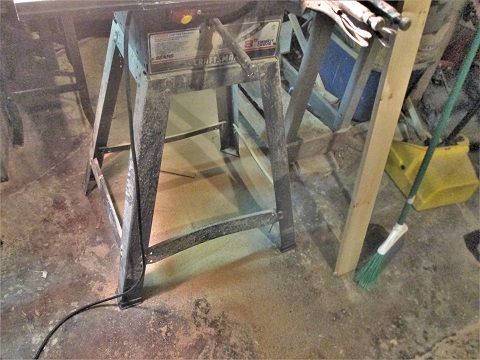
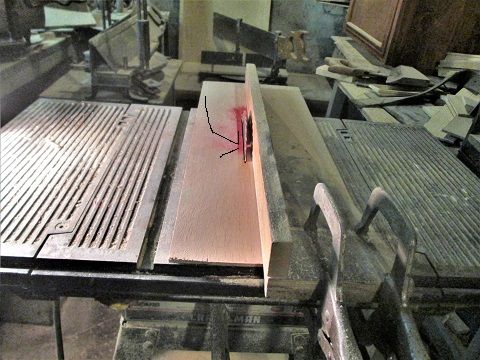
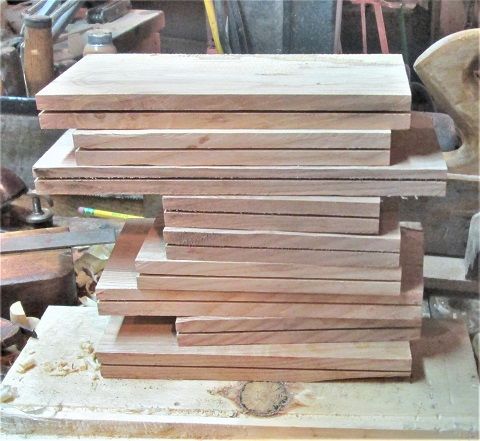
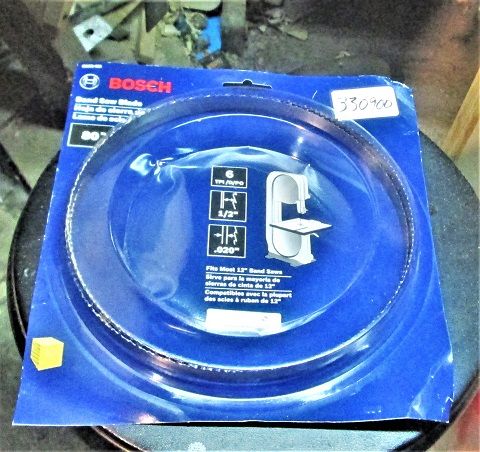
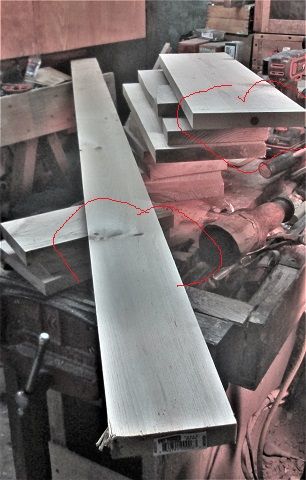
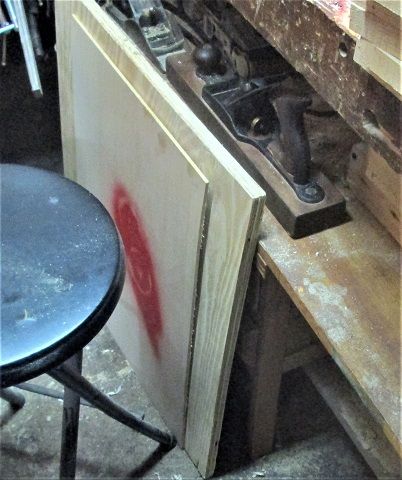
Late start, been under the weather, a bit..... Got bored a bit...needed to resaw a few parts, or at least start a few. Had 10 blanks...tossed out one, too many defects..Tablesaw to get the others the same width....after ripping one edge straight....made a mess doing that There goes the spotless floor....reset the fence, to allow a zero clearance overlay....and set about deadcenter for the stock... About 3/8" between the fence and the blade....then ran the blanks through....bad planning, blade didn't reach to the 1/2 halfway point. We have ways... One on the right, shows how much I missed being the right height...will plane that flat...later Will put a new blade on the bandsaw..later.. 1/2" wide, at that. Have two Ash boards, that need the edges re-done, then I'll rip these for thickness. Same with the Pine one.. If only to get rid of the knots...need drawer parts.....will also rip the 1 x 4 for thickness.. Drawer parts Single Brain Cell Sketch Up is working on the details. May find some use for these two.... Stay tuned...
-

From the album: Tool Cabinet for hand tools
-

From the album: Tool Cabinet for hand tools
-

From the album: Tool Cabinet for hand tools
-

The Five Cent Tour, right hand corner.JPG
steven newman posted a gallery image in General Woodworking

From the album: Tool Cabinet for hand tools
-
The Five Cent Tour, hammer til, keeper strip.JPG
steven newman posted a gallery image in General Woodworking

From the album: Tool Cabinet for hand tools
-

From the album: Tool Cabinet for hand tools
-
The Five Cent Tour, open for business.JPG
steven newman posted a gallery image in General Woodworking

From the album: Tool Cabinet for hand tools
-

From the album: Tool Cabinet for hand tools









.png.9b875e35d4ad286fc52bb5a059d5e2e3.png)